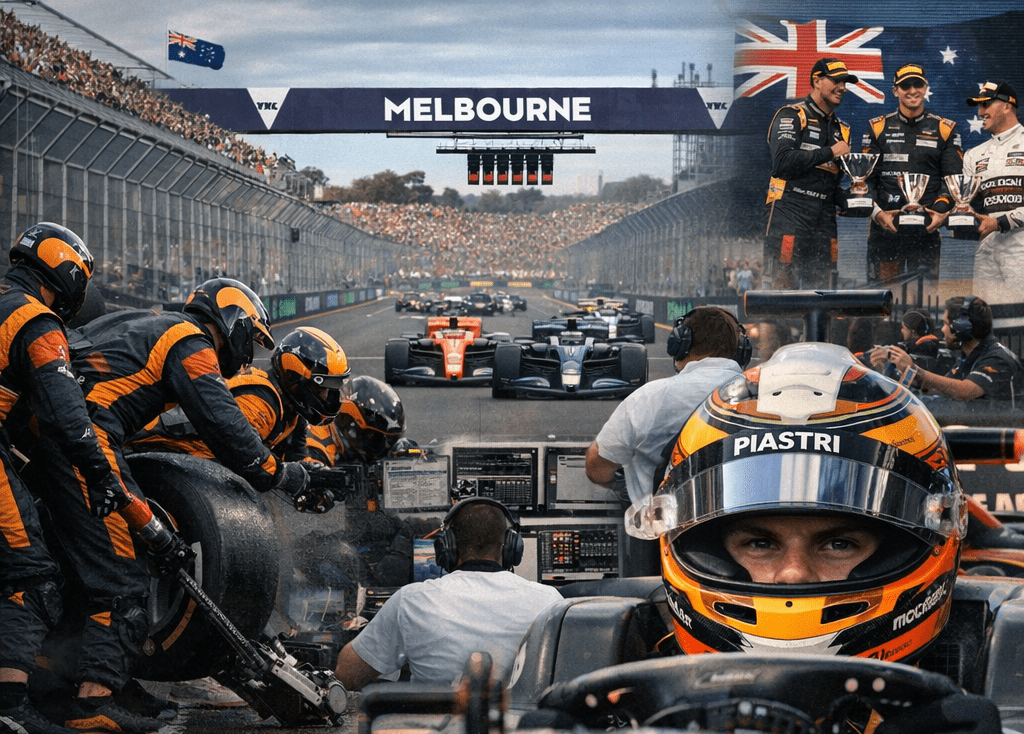
It is the opening round of the Formula One World Championship season, with the Australian Grand Prix in Melbourne once again providing the stage for this high-adrenaline spectacle.
Many people, myself included, enjoy Formula, and what’s not to like? Fast cars, extraordinary driving capability, high-stakes strategy, precision engineering and results that can come down to the smallest of margins. Plus, the pit stops. I am fascinated by pit stops!
I also enjoy Formula 1 because it’s an effective case study for illustrating aspects of ‘talent’ that we benefit from knowing.
If I asked you, “Who or what is talent within the context of Formula 1?”, you are likely to respond with an answer referring to the drivers – the driver cohort or a specific driver. (Go Oscar Piastri!).
And you wouldn’t be alone, because when we talk about talent, we tend to gravitate towards those whom we ‘see’, and in the case of Formula 1, we see the drivers the most. Drivers are the individuals who sit in the cockpit, take the chequered flag, and are rewarded on the podium. Their skill, courage and driving judgment, aka their ‘talents’, are undeniable.
In organisational contexts, we also tend to gravitate towards talking about talent in ways that emphasise those individuals that we ‘see’ – the high-performer, the top salesperson, the charismatic and extraverted leader (you know the ones).
Formula 1 understands that competitive advantage comes from integrating different talent capabilities and roles, and it illustrates something important about talent that we sometimes overlook: that talent is a team sport.
Performance does not occur in isolation.
Behind every driver sits an expansive ecosystem of expertise. Engineers interpret telemetry and continuously adjust the car’s configuration. Strategists model race scenarios, weather patterns (particularly important given Melbourne’s ever-changing weather), tyre degradation, and competitor behaviour in real-time. Pit crews execute tyre changes in under three seconds. Designers and aerodynamicists spend months shaping car components measured in millimetres. And then there are the Team Principals who coordinate the whole system (and who we now see more because of their Drive to Survive interviews). Performance, points and wins emerge not from a single driver, but from a team of talent.
(And yes, there is also the ‘car’ – but I’ll hold off talking about the car for another time).
So, when you are watching Formula 1, take a moment to think about all the people that you do not see. Remember that hundreds of people work ‘behind the scenes’ to help the driver and the team succeed.
The driver may be the most visible talent we see, but talent is a team sport, and the team makes effective performance possible. (And again, Go Oscar Piastri!).
 Sharna Wiblen